Search in blog
Blog tags
Photo gallery
No featured images
To understand this method, imagine a right-angled triangle:
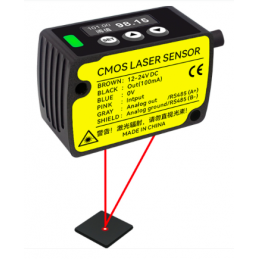
1. Laser source: Emits a laser beam at a known angle (e.g., 45°) towards the object being measured.
2. Object: The laser beam creates a bright spot on its surface.
3. Reflection: Light reflects off the object at different angles (diffusive scattering).
4. Receiver (Detector): A special photosensitive sensor (e.g., CCD or CMOS, similar to those in cameras) is placed at a known distance from the laser source (this is the basis of triangulation). The receiver "sees" the laser spot, but it doesn't look at it perpendicularly, but from a different, known angle.
5. Position Measurement: As the object moves, the position of the laser spot on the detector changes.
· Closer Object: The spot falls on a different part of the detector (e.g., higher).
· Farther Object: The spot falls on a different part of the detector (e.g., lower).
6. Calculations: The electronic circuit (processor) calculates the precise distance to the object based on the known position of the spot on the detector, the laser emission angle, and the length of the triangulation base using trigonometric functions (hence the name "triangulation").
A simple comparison is human stereoscopic vision. Two eyes (two points of view) see an object from slightly different angles. The brain is able to determine distance based on this difference. In laser triangulation, "one eye" is the laser, and the "other eye" is the detector.
--
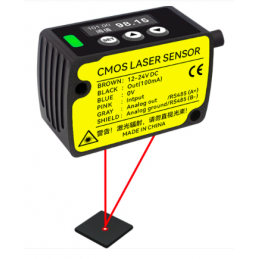
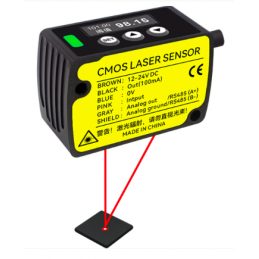
The following diagram illustrates the key elements and the measurement principle:
This method is extremely popular due to its precision and speed. It is used in:
· 3D scanning: Laser scanners for digitizing objects, reverse engineering, and quality control.
· Distance measurement: Proximity and distance sensors in industrial automation.
· Dimensional inspection: Measurement of thickness, straightness, flatness, and roughness.
· Robotics: Vision systems for navigation and object identification.
· Metrology: Precise measurements of micro- and macro-surface geometry.
---
1. Vertex Configuration (Split): The laser and detector are physically separated, creating a wide triangulation base. This is the most common configuration.
2. Common Optical Axis Configuration: The laser and detector are positioned on the same optical axis using special mirrors. It is less susceptible to obscuration but has a smaller measurement range.
Advantages Disadvantages
Very high precision (down to fractions of a micrometer)
Susceptible to optical interference: Shiny, mirror-like surfaces scatter light into a narrow beam that may not reach the detector.
High Resolution
Sensitivity to Color and Texture: Dark or black materials absorb more light, resulting in a weaker signal.
Fast Response Time (Real-Time Measurement)
Blind Spot: Objects too close or too far away may be invisible to the detector.
Contactless measurement (no damage to the measured surface) Obstruction: If something comes between the sensor and the object, measurement is impossible.
Our offer includes products that allow for measurement using the triangulation method. You can find them here: https://morkom-tech.com/en/95-laser-dispalcement-sensors
The laser triangulation method is the foundation of modern, precise optical metrology. Thanks to its simplicity, speed, and exceptional accuracy, it has found indispensable applications in industry, engineering, and scientific research wherever fast and precise distance or shape measurement is required without physical contact with the object.
The use of safety curtains in industry
Absolute measuring potentiometers of the LCF, LPF and LTF series
Safety Light Curtain Controllers
Strain Gauges – What are they and how do they work?
ALS-D Series Optical Scales: precision in every detail